Name: Cary
Date: Sun, 21 Apr 2002 18:24:49 -0600
Subject: Davis: Re: incoming
Davis, our prediction for major to severe storming could be a bit on the high side. Our prediction is probably the highest of any forecast
center. Boulder is only expecting active to minor storm conditions. Spaceweather.com is expecting similar conditions, but I don't know
whether they formulate their own predictions or whether their predictions are heavily based upon SECs opinion. Our predictions are
independent of any other organization, although we do take interest in what they predict as well - but that doesn't mean we bias our
predictions to fall in line with theirs. The forecaster responsible for todays prediction noted that activity on the visible disk involved a
much wider area than the flare site itself. There was a rapid filament eruption as well as an eastward motion of mass (which oddly isn't
discussed or noted by any other forecast group) involved with the CME. It is our opinion that this event had a wide cone angle.
Although this will in all probability remain a flanking impact, the disturbance velocity is high enough to suggest we could still see some
substantial activity - particularly if the disturbance is as wide as we believe it may be. It is also interesting to note that with the other two
CMEs launched by this region, forecasters almost consistently underpredicted the ensuing activity. In every case the disturbances
launched by 9906 have proven to be more geoeffective than expected. That certainly doesn't mean that this disturbance will live up to
our expectations. We're a bit farther out on the limb than more other forecasters. But most of our clients would rather that we
overpredict rather than underpredict. At least that way, they can be prepared for the worst instead of being taken by surprise.
Name: Cary
Date: Sun, 21 Apr 2002 22:28:54 -0600
Subject: Jan: Re: eastward motion
Yes, Jan, the filament channel eruption was a part of the eastward motion I was referring to. The problem (in part) is this: the CME was
clearly associated with more than just the flaring site. Parts of the filament channel that also erupted with the flare were located more
than 30 degrees east of Region 9906. This was a very complex mass ejection. Clearly the highest velocity component was directed
westward, but it is possible that a good portion of that high velocity activity may have been directed earthward as well. It's impossible to
determine with any certainty some of the most crucial parameters: the width of the CME; the Earthward-directed velocity of the
CME, etc.
With respect to the width problem, the CME clearly affected streamers across the entire region of the Sun. It's therefore reasonable to
assume that the Earth is in the path of the CME.
So if the Earth is in the path, then what might be the velocity of that component that is directed Earthward? Usually the radial velocity of
the fastest component is used to establish a base-line with other areas of the CME. In this case, an Earthward-directed velocity in
excess of 1,000 km/sec is certainly not out of the question. I would say that 1,600 km/sec is on the high side. You see, the problem is
directly related to the width of the CME. If you guess the width wrong, your velocity estimate will also be wrong. But powerful solar flares
such as this are often associated with large spatial widths. The other major problem with determining Earthward velocities is that the
true Earthward velocity of a CME is not possible to determine from SOHO imagery. Imagine standing on a railroad track and watching a
train that is far off in the distance. Can you tell what velocity it is travelling at just by observing it from your location? It isn't possible. You
need more than one observation point (one point away from the line-of-sight direction) to define motion toward you. So we are severely
handicapped. All we can use is the observed fastest radial velocity of the CME and then empirically derive estimates of radial velocity
based on the observations and assumptions of the CMEs width. But observed velocities away from the highest-velocity radial location
do not always follow nice empirical rules. The situation is simply too complex for us to model accurately - even with CMEs that have
classic textbook perfect characteristics. There may be deformations in the shock front, interaction with higher (or lower) velocity solar
wind components enroute to the Earth, interaction with the heliospheric current sheet, interaction with other ejected matter, large
density fluctuations, cavities in density, etc. These can all change the characteristics and even the shape of the CME before it reaches
the Earth.
Time will tell... We (STD) could well be wrong with this one and may be way out in left field. If so, I'll be the first to admit it if we are. But
my personal "gut feeling" (intuition matured by experience) is leaning toward a higher-end impact where periods of major to severe
storming may be possible.
With respect to your question on IMF magnitudes... yes, the higher the velocity of the CME, the stronger the imbedded magnetic fields
are. They aren't necessarily proportional in a linear sense, but they are definitely correlated strongly with velocity. Three-dimensional
magnetohydrodynamic simulations of fast CMEs have often shown enhanced compression of magnetic fields east and west of the
central pulse axis. This can produce a potentially stronger geoeffective impact than perhaps a direct strike. Studies that claim to have
observed these types of disturbance asymmetries have been conducted using multiple spacecraft outside of Earth orbit (ex. Ulysses,
spacecraft enroute to Mars, our own near-Earth spacecraft, etc.). So your feeling that some past CMEs that were just supposed to skim
by the Earth that ended up producing stronger than expected storms may have some justification in fact.
But accurately modelling this particular CME is almost impossible to do with any reliability given the complexity of the situation.
Disturbances like this can produce very strong IMF Bt levels approaching 70 to 100 nT, but given our trailing position with respect to
the CME, the strength will probably be considerably less - perhaps in the 30 to 50 nT range if we're right about this event, or lower (15
to 30 nT) if SEC is right.
It will be interesting to see what happens...
Gründe für die "hohe" Prognose des STD
-
Thomas Sävert
also nix ist klar
Moin Ulrich,
man weiss also eigentlich nicht viel. Wir müssen einfach abwarten und mit allem rechnen. Das schließt einen Mafor Storm genauso ein wie den Fall, dass (fast) gar nichts passiert. Das Wetter macht mir auch große Sorgen.
Gruß, Thomas Sävert
man weiss also eigentlich nicht viel. Wir müssen einfach abwarten und mit allem rechnen. Das schließt einen Mafor Storm genauso ein wie den Fall, dass (fast) gar nichts passiert. Das Wetter macht mir auch große Sorgen.
Gruß, Thomas Sävert
-
Thomas Sävert
Also nix ist klar...
Moin Ulrich,
man weiss also eigentlich nicht viel. Wir müssen einfach abwarten und mit allem rechnen. Das schließt einen Mafor Storm genauso ein wie den Fall, dass (fast) gar nichts passiert. Das Wetter macht mir auch große Sorgen.
Gruß, Thomas Sävert
man weiss also eigentlich nicht viel. Wir müssen einfach abwarten und mit allem rechnen. Das schließt einen Mafor Storm genauso ein wie den Fall, dass (fast) gar nichts passiert. Das Wetter macht mir auch große Sorgen.
Gruß, Thomas Sävert
-
Heiko
Wenn Dir das Wetter Sorgen macht, wird's wohl doch was .....
Wenn Dir das Wetter Sorgen macht, wird's wohl doch was ....... *o.T.*
-
jan lameer
yeah the weather, I'd say it will be perfect halo conditions
yeah the weather, I'd say it will be perfect halo conditions in a few hours (tear tear tea
-
Ulrich Rieth
...im Gegenteil...
...wer die Warnungen des STD immer aufmerksam beachtet hat, weiss, dass sie wirklich seeeehr konservativ an die Sache ran gehen.
Hier ist jetzt, zwar nur zwischen den Zeilen, zu erkennen, dass eigentlich alle dort drüben in Kanada von einem Monster-CME ausgehen.
Man sagt zwar, dass es "nur" wegen der Kunden diese hochangesetzte Warnung gibt, damit man sich bei etwaigen Schäden nicht entschuldigen und teuer zahlen muss. Aber dahinter steckt da nicht nur blose Vermutung.
Wie ich die Lage sehe, kann man mit einem G3 Sturm rechnen, aber es ist auch ein G4 drin.
Natürlich muss man auch darauf hinweisen, dass es in der Vergangenheit schon CME's aus deutlich besseren Positionen gab, die dann garnichts gebracht haben.
Aber(!!!), so gut wie alle Ereignisse mit starken Ausbrüchen aus dem Südwest-Quadranten brachten IMMER fette Stürme.
Als Paradabeispiel (und weil ich, im Gegensatz zu Peter *wink* mir nicht alle Events merken kann) nenne ich hier nur den CME aus dem äußersten Südwesten, der die fetten PL's am 06./07.04.2000 brachte.
Gruß
Ulrich
Hier ist jetzt, zwar nur zwischen den Zeilen, zu erkennen, dass eigentlich alle dort drüben in Kanada von einem Monster-CME ausgehen.
Man sagt zwar, dass es "nur" wegen der Kunden diese hochangesetzte Warnung gibt, damit man sich bei etwaigen Schäden nicht entschuldigen und teuer zahlen muss. Aber dahinter steckt da nicht nur blose Vermutung.
Wie ich die Lage sehe, kann man mit einem G3 Sturm rechnen, aber es ist auch ein G4 drin.
Natürlich muss man auch darauf hinweisen, dass es in der Vergangenheit schon CME's aus deutlich besseren Positionen gab, die dann garnichts gebracht haben.
Aber(!!!), so gut wie alle Ereignisse mit starken Ausbrüchen aus dem Südwest-Quadranten brachten IMMER fette Stürme.
Als Paradabeispiel (und weil ich, im Gegensatz zu Peter *wink* mir nicht alle Events merken kann) nenne ich hier nur den CME aus dem äußersten Südwesten, der die fetten PL's am 06./07.04.2000 brachte.
Gruß
Ulrich
-
jan lameer
I meant atmospheric halos, there is a very light milkish whi
I meant atmospheric halos, there is a very light milkish white sky *o.T.*
-
Heiko
So wie es momentan aussieht, ziehen vom NW Schleierwolken re
So wie es momentan aussieht, ziehen vom NW Schleierwolken rein - waere bitter !! *o.T.*
-
Martin Liebermann
22° halo - sky completely veiled with cirrostratus in Bielef
22° halo - sky completely veiled with cirrostratus in Bielefeld *oT*
-
Peter Kuklok
G3er vom 18.4.2001
Hallo,
> Wie ich die Lage sehe, kann man mit einem G3 Sturm rechnen, aber
> es ist auch ein G4 drin.
> Natürlich muss man auch darauf hinweisen, dass es in der
> Vergangenheit schon CME's aus deutlich besseren Positionen gab,
> die dann garnichts gebracht haben.
> Aber(!!!), so gut wie alle Ereignisse mit starken Ausbrüchen aus
> dem Südwest-Quadranten brachten IMMER fette Stürme.
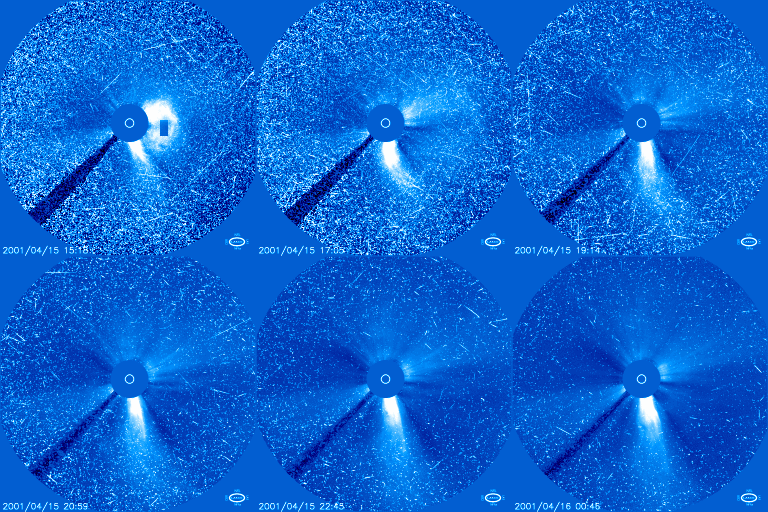
ein weiteres schönes Beipiel ist auch der bereits erwähnte "echte" Megaflare von Mitte April 2001. Den hatte zunächst niemand auf der Rechnung, da er so extrem weit am Westrand seinen Ursprung hatte. Die LASCO-Aufnahmen zeigten keine eindeutige erdgerichtete Komponente. Dennoch gab es am 18.4. einen kurzen aber knackigen G3-Sturm mit Tendenz zum G4er:
SOHO Hotshots
http://soho.nascom.nasa.gov/hotshots/2001_04_15/
C3-Anim
http://www.spaceweather.com/images2001/ ... c3_big.gif
Kp-Indizes
http://www.peterkuklok.de/kp/20010419kp.gif
MAG + SWEPAM
http://www.peterkuklok.de/pic/swepam010419.gif
EPAM
http://www.peterkuklok.de/pic/epam010419.gif
In Anbetracht der Tatsache, dass die aktuelle Eruption komplexer und die erdgerichtete Komponente offensichtlicher ist, würde ich einen G3-Sturm als eine absolut realistische Prognose einschätzen.
> Als Paradabeispiel (und weil ich, im Gegensatz zu Peter *wink*
> mir nicht alle Events merken kann)
Joo danke, schön wärs *zurückwink*
> nenne ich hier nur den CME
> aus dem äußersten Südwesten, der die fetten PL's am
> 06./07.04.2000 brachte.
Grüße
Peter
> Wie ich die Lage sehe, kann man mit einem G3 Sturm rechnen, aber
> es ist auch ein G4 drin.
> Natürlich muss man auch darauf hinweisen, dass es in der
> Vergangenheit schon CME's aus deutlich besseren Positionen gab,
> die dann garnichts gebracht haben.
> Aber(!!!), so gut wie alle Ereignisse mit starken Ausbrüchen aus
> dem Südwest-Quadranten brachten IMMER fette Stürme.
ein weiteres schönes Beipiel ist auch der bereits erwähnte "echte" Megaflare von Mitte April 2001. Den hatte zunächst niemand auf der Rechnung, da er so extrem weit am Westrand seinen Ursprung hatte. Die LASCO-Aufnahmen zeigten keine eindeutige erdgerichtete Komponente. Dennoch gab es am 18.4. einen kurzen aber knackigen G3-Sturm mit Tendenz zum G4er:
SOHO Hotshots
http://soho.nascom.nasa.gov/hotshots/2001_04_15/
C3-Anim
http://www.spaceweather.com/images2001/ ... c3_big.gif
Kp-Indizes
http://www.peterkuklok.de/kp/20010419kp.gif

MAG + SWEPAM
http://www.peterkuklok.de/pic/swepam010419.gif

EPAM
http://www.peterkuklok.de/pic/epam010419.gif

In Anbetracht der Tatsache, dass die aktuelle Eruption komplexer und die erdgerichtete Komponente offensichtlicher ist, würde ich einen G3-Sturm als eine absolut realistische Prognose einschätzen.
> Als Paradabeispiel (und weil ich, im Gegensatz zu Peter *wink*
> mir nicht alle Events merken kann)
Joo danke, schön wärs *zurückwink*
> nenne ich hier nur den CME
> aus dem äußersten Südwesten, der die fetten PL's am
> 06./07.04.2000 brachte.
Grüße
Peter
-
Peter Wloch
Re: Jan, make something special from it with artistic Intuit
Re: Jan, make something special from it with artistic Intuition... *o.T.*
-
Thomas Sävert
Ihr habt schon recht, aber...
Hallo Peter und Ulrich,
das stimmt schon. Ich kann mich auch an einige Fälle erinnern, die aus dem Südwestquadranten uns ordentlich einzeizten, um es mal salopp zu formulieren.
Dennoch möchte ich mich der Euphorie noch nicht so recht anschließen. Ich bin da etwas vorsichtiger, aber natürlich auch auf alles gefasst. Filme liegen bereits, trotz Wolken (hier jetzt zu mit 8/8), Auto ist vollgetankt, alles startbereit, auch Proviant wie Schokolade etc. ist schon bereit.
Ihr seht also, ich nehm das Teil auch ernst, auf jeden Fall!!!
Gruß, Thomas Sävert
das stimmt schon. Ich kann mich auch an einige Fälle erinnern, die aus dem Südwestquadranten uns ordentlich einzeizten, um es mal salopp zu formulieren.
Dennoch möchte ich mich der Euphorie noch nicht so recht anschließen. Ich bin da etwas vorsichtiger, aber natürlich auch auf alles gefasst. Filme liegen bereits, trotz Wolken (hier jetzt zu mit 8/8), Auto ist vollgetankt, alles startbereit, auch Proviant wie Schokolade etc. ist schon bereit.
Ihr seht also, ich nehm das Teil auch ernst, auf jeden Fall!!!
Gruß, Thomas Sävert
Wer ist online?
Mitglieder in diesem Forum: 0 Mitglieder und 7 Gäste