Begin03.03 26.2. 2004
HEUREKA !
564 X-FLARE ! :-)
Moderator: StefanK
-
Peter Wloch
- Beiträge: 268
- Registriert: 9. Jan 2004, 15:55

-
Peter Wloch
- Beiträge: 268
- Registriert: 9. Jan 2004, 15:55
Irren ist menschlich :-)
Und das meinten die Experten.
Nur mal als historisches Beispiel, das die auch nur mit Wasser kochen...
TODAYS SPACEWEATHER
3-day Solar-Geophysical Forecast issued Feb 25 at 22:00 UTC
Solar Activity Forecast: Solar activity is expected to be low. Region 564, which will remain on the visible disk through 28 February, continues to have the potential for C-class activity, with a very slight chance of an isolated M-class event.
Geophysical Activity Forecast: The geomagnetic field is expected to be at quiet to unsettled levels.
http://www.sec.noaa.gov/today2.html

Nur mal als historisches Beispiel, das die auch nur mit Wasser kochen...
TODAYS SPACEWEATHER
3-day Solar-Geophysical Forecast issued Feb 25 at 22:00 UTC
Solar Activity Forecast: Solar activity is expected to be low. Region 564, which will remain on the visible disk through 28 February, continues to have the potential for C-class activity, with a very slight chance of an isolated M-class event.
Geophysical Activity Forecast: The geomagnetic field is expected to be at quiet to unsettled levels.
http://www.sec.noaa.gov/today2.html
-
Norbert Bläsner, Dresden
- Beiträge: 363
- Registriert: 9. Jan 2004, 10:35
- Wohnort: Heidenau bei Dresden
Überraschung
Die Gruppe 564 ist ja auch in kürzester Zeit riesig geworden...die beiden einzelnen Spots von gestern sind ja auf einmal verbunden...Größe 1050 bei dxlc
ich denk mal auf Grund der Entwicklung der Gruppe war es auch nicht vorhersehbar!
ich denk mal auf Grund der Entwicklung der Gruppe war es auch nicht vorhersehbar!
-
Sinclair
Morgen,
Was ich nicht verstehe sind dann eben solche Vorraussagen, da man ja beim Beobachten der entsprechenden Bilder selbst als Laie erkennt das mittlerweile die Spots größtenteils von einer penumbra verbunden sind, man heftige positve und negative Regionen hat die andauernd in Bewegung sind was ja eine Vermischung zu einen beta-gamma-delta(ich hab dazugelernt ) wahrscheinlich machen und dann noch die Größe die nach dxlc.com schon die 1000 überschritten hat !
Das alles zusammen schreit doch quasi nach Major Events oder sehe ich das jetzt als Laie zu einfach ?
Oder war das jetzt doch zu überraschend aus Experten Sicht, wenn ja mach ich mir langsam Sorgen um die Experten oder die Sonne, einer von beiden will dann wohl nicht so wie der Andere :mrgreen:.
Also ich würde jetzt laienmäßig so rangehen ,man hat die oben beschriebene Situation , also sucht man sich einen Vergleich wie z.B diesen:
Jahr: 2000
Sunspot: 9077
Größe: 1010

Größter Flare : X6 am 14.Juli 2000 davor ein X2 12.juli:
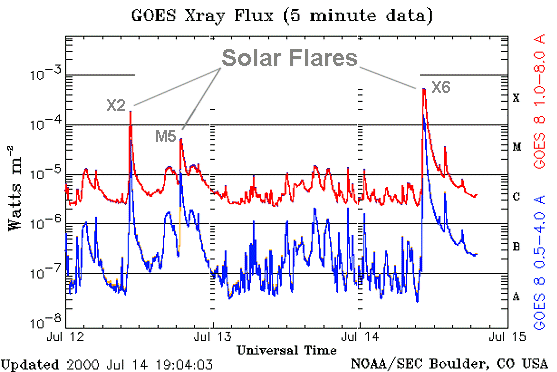
Fazit vergleichbare Werte, ergo das könnte auch 564 bringen(ja gut das war zum Solaren Maximum,aber ist das nicht mittlerweile irrelevant ?), Vorraussage fertig, so einfach kann das sein ok ok das war jetzt wohl zu einfach aber im Prinzip ?
by the way wenn das Teil seine 100 % Wachstumsrate pro Tag weiterbeibehält steigt nach meiner Meinug auch die Chance das es sich in die Flarehitliste einträgt ,nur mal so theoretisch gesehen
gruß aus Berlin
Andy
Tja was soll man dazu sagen mit einen Schlag alle Vorraussagen über den haufen geworden.Und das meinten die Experten.
Nur mal als historisches Beispiel, das die auch nur mit Wasser kochen...
Was ich nicht verstehe sind dann eben solche Vorraussagen, da man ja beim Beobachten der entsprechenden Bilder selbst als Laie erkennt das mittlerweile die Spots größtenteils von einer penumbra verbunden sind, man heftige positve und negative Regionen hat die andauernd in Bewegung sind was ja eine Vermischung zu einen beta-gamma-delta(ich hab dazugelernt
) wahrscheinlich machen und dann noch die Größe die nach dxlc.com schon die 1000 überschritten hat !Das alles zusammen schreit doch quasi nach Major Events oder sehe ich das jetzt als Laie zu einfach ?
Oder war das jetzt doch zu überraschend aus Experten Sicht, wenn ja mach ich mir langsam Sorgen um die Experten oder die Sonne, einer von beiden will dann wohl nicht so wie der Andere :mrgreen:.
Also ich würde jetzt laienmäßig so rangehen ,man hat die oben beschriebene Situation , also sucht man sich einen Vergleich wie z.B diesen:
Jahr: 2000
Sunspot: 9077
Größe: 1010
Größter Flare : X6 am 14.Juli 2000 davor ein X2 12.juli:
Fazit vergleichbare Werte, ergo das könnte auch 564 bringen(ja gut das war zum Solaren Maximum,aber ist das nicht mittlerweile irrelevant ?), Vorraussage fertig, so einfach kann das sein
ok ok das war jetzt wohl zu einfach aber im Prinzip ?by the way wenn das Teil seine 100 % Wachstumsrate pro Tag weiterbeibehält steigt nach meiner Meinug auch die Chance das es sich in die Flarehitliste einträgt ,nur mal so theoretisch gesehen
gruß aus Berlin
Andy
-
Norbert Bläsner, Dresden
- Beiträge: 363
- Registriert: 9. Jan 2004, 10:35
- Wohnort: Heidenau bei Dresden
Anderer Grund
Die Berichte kommen nur täglich raus...daher zu altes Datenmaterial denke ich...
-
Thomas Sävert

- Beiträge: 250
- Registriert: 17. Jan 2004, 10:33
- Wohnort: Velbert
- Kontaktdaten:
Nur schwache Auswirkungen auf Erdmagnetfeld?
Moin zusammen,
dann kommt schon mal ein X-Flare und dann natürlich zu einer Zeit, während der man doch tatsächlich mal schläft
Meint Ihr wirklich, dass uns das was bringt? Die Richtung ist zwar nicht schlecht, aber war das nicht etwas kurz? Ich bin da - auch ohne Bilder - schon mal etwas skeptisch.
Gruß, Thomas Sävert
dann kommt schon mal ein X-Flare und dann natürlich zu einer Zeit, während der man doch tatsächlich mal schläft
Meint Ihr wirklich, dass uns das was bringt? Die Richtung ist zwar nicht schlecht, aber war das nicht etwas kurz? Ich bin da - auch ohne Bilder - schon mal etwas skeptisch.
Gruß, Thomas Sävert
-
Sinclair
Mag sein , aber z.B der Noaa Bericht kommt um 22:00 UTC was 23:00 Uhr unserer Zeit ist da bestand die Situation eigendlich schon und der 564 hat sich ja auch die Tage vorher rasant weiterentwickelt,naja egal für uns ist ja dieses nicht Vorraussagbare das Spannende an der Sache aber ich stell mir mal jemanden vor der einen Satelliten in die Umlaufbahn schießen will, verläßt sich auf die Vorraussage "alles schick" schießt das Teil in den Orbit und dann heftig Flare und tschüss Satellite :mrgreen:
-
Norbert Bläsner, Dresden
- Beiträge: 363
- Registriert: 9. Jan 2004, 10:35
- Wohnort: Heidenau bei Dresden
Stimmt
war etwas sehr kurz! Aber skeptisch bist du ja von Grund auf...außerdem ist das Wetter wohl eh net besonders und ich selbst hab in den nächsten Tagen immer was vor...ein PL wär persönlich gesehen ungünstig....*g*
Aber warten wir die Bilder ab, dann wissen wir mehr...
Aber warten wir die Bilder ab, dann wissen wir mehr...
-
Norbert Bläsner, Dresden
- Beiträge: 363
- Registriert: 9. Jan 2004, 10:35
- Wohnort: Heidenau bei Dresden
Eher wenig zu erwarten
Thomas hat ja schon geschriebn dass das Ereignis eher kurz war... spacew.com schreibt folgendes
Latest Geomagnetic and Auroral Activity Conditions
Updated: 11:15 UTC 26 February (6:16 am EDT, 26 February):
A geomagnetic response from today's X-class solar flare is possible. At the present time, there is insufficient data available to determine a forecast. We are awaiting the arrival of additional data before determining a forecast. A very preliminary suggestion is that this event may have only a minimal impact on 28 or 29 February.
Solar Activity Update
Region 564 unleashed a class X1.1/2N solar flare at 02:03 UTC on 26 February. This event was not very spectacular. But its occurrence suggests additional major flare activity may be possible.
Latest Geomagnetic and Auroral Activity Conditions
Updated: 11:15 UTC 26 February (6:16 am EDT, 26 February):
A geomagnetic response from today's X-class solar flare is possible. At the present time, there is insufficient data available to determine a forecast. We are awaiting the arrival of additional data before determining a forecast. A very preliminary suggestion is that this event may have only a minimal impact on 28 or 29 February.
Solar Activity Update
Region 564 unleashed a class X1.1/2N solar flare at 02:03 UTC on 26 February. This event was not very spectacular. But its occurrence suggests additional major flare activity may be possible.
-
Udo, DK5YA
Oler's comment
A s t r o A l e r t
Sun-Earth Alert
Solar Terrestrial Dispatch
http://www.spacew.com
26 February 2004
MAJOR X-CLASS SOLAR FLARE ALERT
A major solar flare has been observed from the sunspot complex known as
Region 564. This sunspot complex is large enough to be seen with the unaided
(but protected!) eye. It is currently slightly west of the central solar
meridian and will not rotate behind the western limb of the Sun and out of
view for approximately another 6 days. It's persisting growth also bodes well
for possible periods of enhanced northern lights activity over the coming
week.
Today's major class X1.1 solar flare occurred at 02:03 UTC on 26
February. It was not a particularly spectacular event, but its position is
excellent for ejecting mass toward the Earth. The Earth stands a good chance
to see a minor coronal mass ejection impact within the next 2 to 4 days. An
accurate assessment is not yet possible due to an inadequate amount of
available data. Once additional data has been received, forecasts will start
appearing on the various web sites (www.sec.noaa.gov, www.spacew.com, etc).
The likelihood of a large impact capable of producing significant auroral
activity is fairly low. Nevertheless, a middle latitude aurora watch will
probably be issued within the next 24 hours (don't expect any enhanced
auroral activity from this event within the next 36 to 48 hours). If a watch
is issued, another Astroalert will likewise be sent out.
Sunspot complex 564 may be capable of supporting an additional major
solar flare.
** End of the AstroAlert Bulletin **
Sun-Earth Alert
Solar Terrestrial Dispatch
http://www.spacew.com
26 February 2004
MAJOR X-CLASS SOLAR FLARE ALERT
A major solar flare has been observed from the sunspot complex known as
Region 564. This sunspot complex is large enough to be seen with the unaided
(but protected!) eye. It is currently slightly west of the central solar
meridian and will not rotate behind the western limb of the Sun and out of
view for approximately another 6 days. It's persisting growth also bodes well
for possible periods of enhanced northern lights activity over the coming
week.
Today's major class X1.1 solar flare occurred at 02:03 UTC on 26
February. It was not a particularly spectacular event, but its position is
excellent for ejecting mass toward the Earth. The Earth stands a good chance
to see a minor coronal mass ejection impact within the next 2 to 4 days. An
accurate assessment is not yet possible due to an inadequate amount of
available data. Once additional data has been received, forecasts will start
appearing on the various web sites (www.sec.noaa.gov, www.spacew.com, etc).
The likelihood of a large impact capable of producing significant auroral
activity is fairly low. Nevertheless, a middle latitude aurora watch will
probably be issued within the next 24 hours (don't expect any enhanced
auroral activity from this event within the next 36 to 48 hours). If a watch
is issued, another Astroalert will likewise be sent out.
Sunspot complex 564 may be capable of supporting an additional major
solar flare.
** End of the AstroAlert Bulletin **
-
Michael Heiß

- Beiträge: 166
- Registriert: 12. Jan 2004, 15:41
- Wohnort: Greifswald


Wer ist online?
Mitglieder in diesem Forum: 0 Mitglieder und 38 Gäste